What Is HRT and How Does It Work?
A simple guide to hormone replacement therapy in the UK
If you are new to HRT, the whole topic can feel more complicated than it needs to be.
You hear terms like oestrogen, progesterone, patches, gel, tablets, micronised progesterone, perimenopause — and suddenly what should be a straightforward health decision starts sounding like you need a medical dictionary and a strong cup of tea.
The good news is this: HRT is not as confusing as it first looks.
At its core, HRT is simply a treatment used to replace hormones that fall during the menopause transition.

What is HRT?
HRT stands for hormone replacement therapy.
It is mainly used to help with symptoms linked to perimenopause and menopause, when hormone levels begin to change and, over time, decline.
The main hormone involved is oestrogen. This is important because many menopause symptoms are closely linked to falling oestrogen levels.
Depending on the person, HRT may also include progestogen, sometimes testosterone, or other alternatives depending on clinical context.
How does HRT work?
The simple answer is: HRT works by replacing hormones that the body is no longer producing in the same way or in the same amount.
As hormone levels shift, people can develop symptoms such as hot flushes, night sweats, sleep disturbance, mood changes, anxiety, low mood, and vaginal dryness.
Rather than masking symptoms in a vague way, HRT addresses one of the underlying reasons those symptoms happen in the first place: hormonal change.
Why is oestrogen so important?
Oestrogen tends to be the main driver of HRT treatment because it affects much more than hot flushes.
- Temperature regulation
- Sleep
- Vaginal and urinary tissues
- Bone health
- Overall quality of life during the menopause transition
So HRT is not only about making someone feel more comfortable in the short term. In some cases, it also has a longer-term health role.
Why do some people need progesterone too?
This is one of the most important basics to understand.
If someone still has a womb, they usually need progestogen alongside oestrogen. This is because oestrogen on its own can stimulate the lining of the womb.
Womb present: usually oestrogen + progestogen
No womb after hysterectomy: often oestrogen only
What symptoms can HRT help with?
HRT is usually considered because symptoms are affecting daily life.
- Hot flushes
- Night sweats
- Sleep problems
- Mood swings
- Anxiety and low mood
- Vaginal dryness
In practice, many people are not just treating one symptom. They may be trying to improve a whole cluster of issues at once, from poor sleep and brain fog to reduced confidence and intimacy concerns.

What forms of HRT are available in the UK?
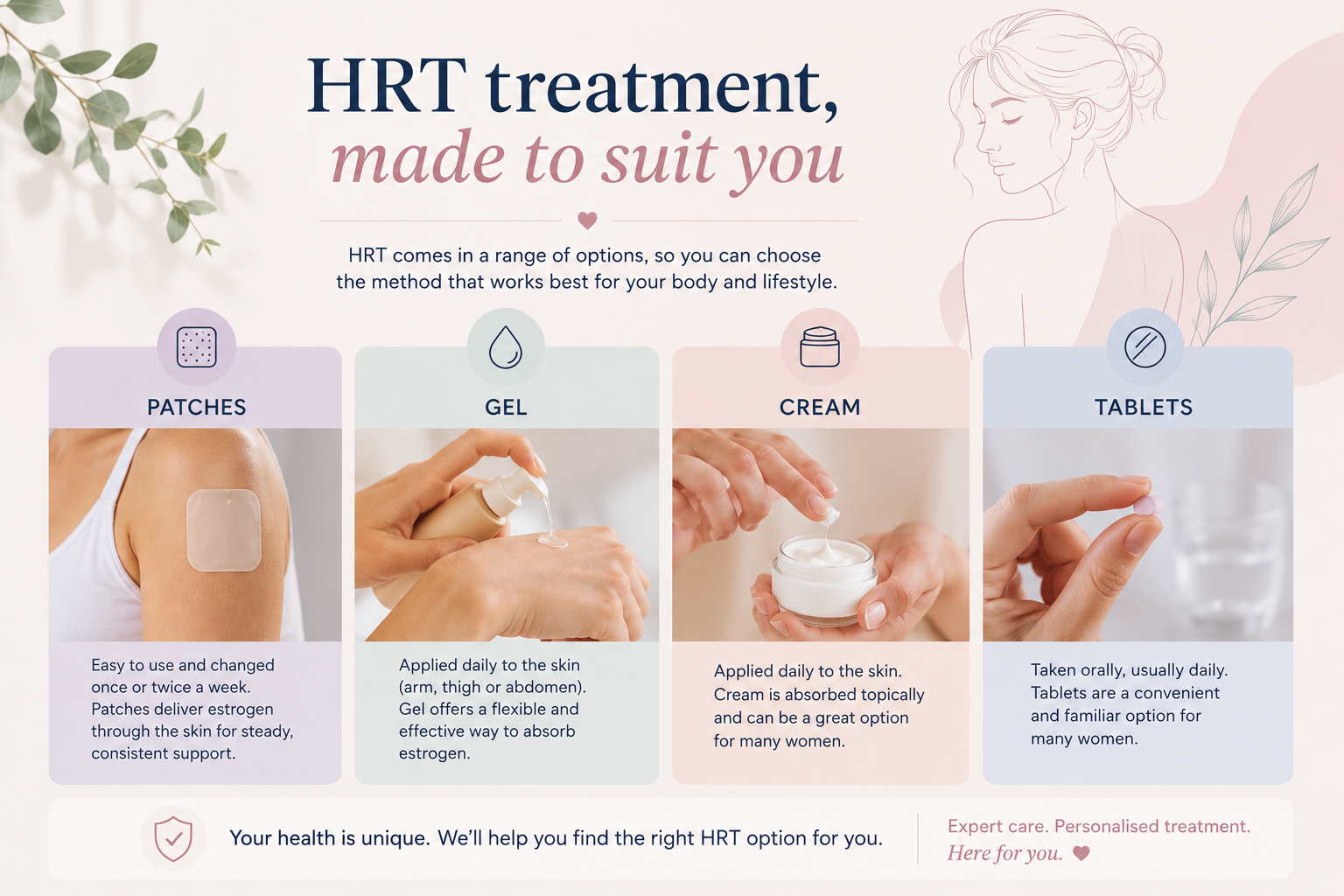
One reason HRT can seem confusing is that there is no single version. HRT can be taken in different forms depending on symptoms, medical history, preference, and clinical suitability.
Tablets
A familiar and simple option for many people.
Patches
Applied to the skin and absorbed through the body over time.
Gel or spray
Absorbed through the skin and often chosen by people who prefer a non-tablet option.
Vaginal oestrogen
Used more locally for vaginal dryness, soreness, or urinary symptoms.
Is one type better than another?
Not universally. The best type depends on the person.
Some people want simplicity. Some want flexibility. Some need womb protection. Some mainly need help with vaginal symptoms. Some may prefer transdermal options such as patches, gels, or sprays.
This is why good HRT care should not be one-size-fits-all.
Does HRT only help with symptoms?
No — not always.
Symptom relief is usually the main reason people start HRT, but it can also have other benefits, including support for bone health in selected situations.
Short-term symptom support
Helping with hot flushes, night sweats, sleep issues, mood changes, and vaginal dryness.
Broader health support
In selected situations, HRT may also support longer-term health considerations such as bone protection.
Can HRT start during perimenopause?
Yes. A lot of people assume HRT is only something you take once periods have completely stopped, but that is not correct.
Many disruptive symptoms can begin during perimenopause, before menopause is officially reached.
What about testosterone?
Testosterone is a growing area of interest, especially in private menopause care.
While oestrogen is the main type of HRT, testosterone may sometimes be considered in selected cases after a proper clinical assessment.
Final thoughts
If you are new to HRT, the simplest way to think about it is this:
HRT replaces hormones that fall during menopause so that symptoms can be better managed and, in some cases, longer-term health can be supported too.
Everything else — the type, the dose, the route, the need for progesterone, and whether additional hormones are discussed — comes after that.
Frequently Asked Questions
What is HRT?
HRT stands for hormone replacement therapy. It is used to replace hormones that fall during perimenopause and menopause.
How does HRT work?
HRT works by replacing hormones that the body is producing at lower levels, helping to manage symptoms linked to hormonal change.
Do I need progesterone with HRT?
If you still have a womb, you will usually need progestogen alongside oestrogen to help protect the womb lining.
Can HRT be started during perimenopause?
Yes. HRT may be considered during perimenopause as well as after periods have stopped.
What forms of HRT are available?
HRT may be available as tablets, patches, gels, sprays, and local vaginal oestrogen.