Is HRT Safe?
What the risks and benefits actually look like
A balanced UK guide to what people worry about most — and what the evidence really says.
If you ask most women what puts them off HRT, the answer is usually not that they do not understand what it is, or that they do not think it could help.
It is usually something more human than that:
“I’m worried about the risks.”
And that is fair. HRT often comes with half-remembered headlines, second-hand warnings, and anxiety around breast cancer, blood clots, stroke, and long-term safety.
But the truth is more nuanced than “safe” or “unsafe.” The better question is: what are the real benefits, what are the real risks, and how do they change depending on the type of HRT and the person taking it?

The short answer
HRT can be very safe for many women, but it is not one-size-fits-all.
It can help with most menopause symptoms and may also support bone health, but it also has risks and may not be suitable for everyone.
HRT is not a single treatment with a single risk profile. A patch is not the same as a tablet. Oestrogen-only HRT is not the same as combined HRT.
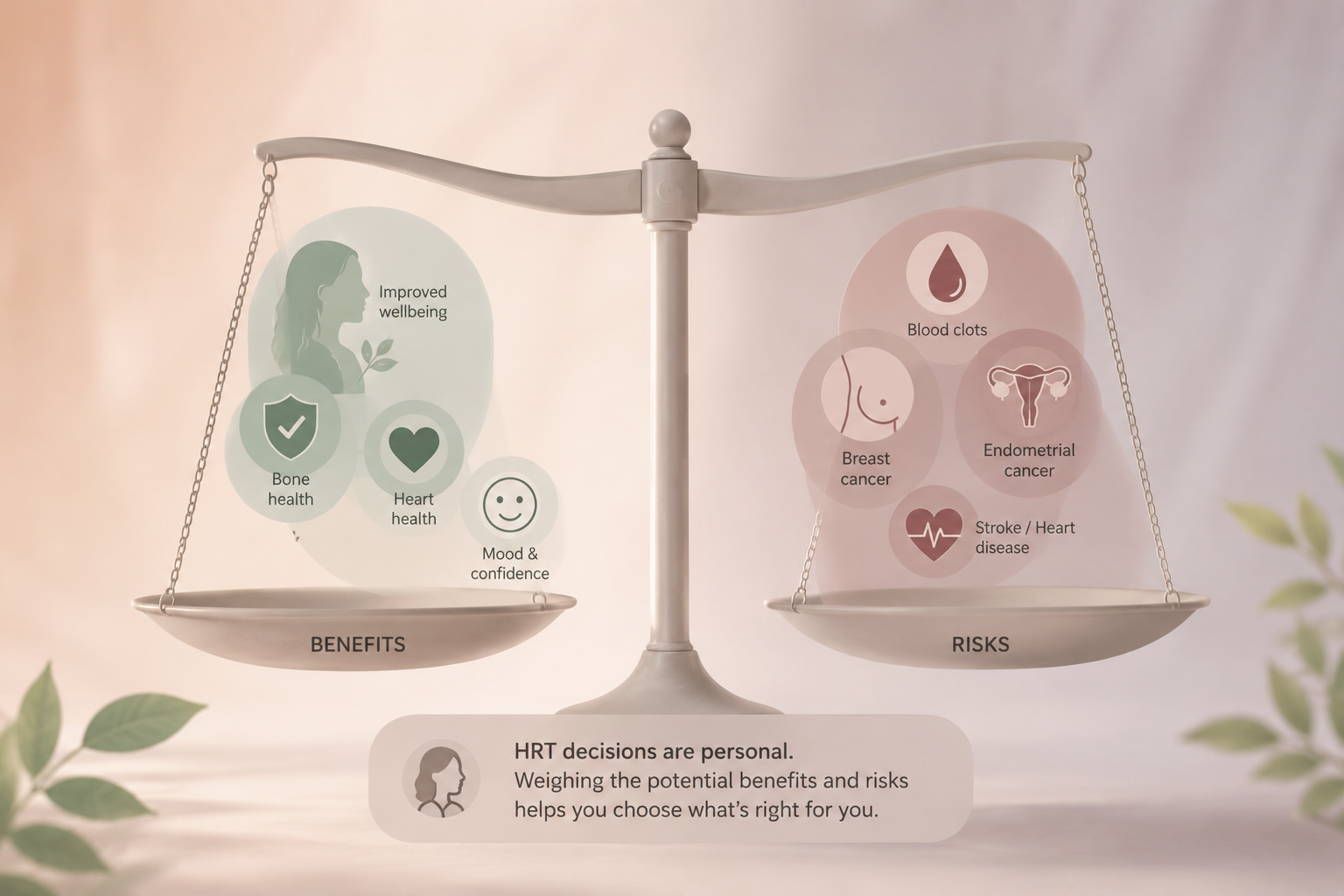
Main benefits of HRT
Before getting lost in risk discussions, it is worth being honest about why HRT is prescribed in the first place.
Symptom relief
HRT may help with hot flushes, night sweats, poor sleep, mood symptoms, and vaginal dryness.
Quality of life
For many women, treatment is about feeling more normal again in day-to-day life.
Bone protection
In the right context, HRT may help reduce weakening of the bones and support longer-term health.
Why people worry
People worry because there are real risks — but those risks are often discussed in a vague or exaggerated way.
- Breast cancer
- Blood clots
- Stroke
- Womb cancer risk without proper womb protection
- Suitability with certain medical histories
That does not mean HRT is inherently dangerous. It means it should be chosen carefully and prescribed properly.

Breast cancer risk
This is the issue that creates the most anxiety.
Some types of HRT can slightly increase the risk of breast cancer. The risk is generally small, and it increases the longer HRT is used.
The risk also differs depending on the type of HRT. Combined HRT is usually the form most associated with this increase, while oestrogen-only HRT has a different risk profile.
Yes, there can be a small increase in breast cancer risk with some types of HRT, especially combined HRT and longer use. But the absolute increase is usually small, and the risk profile is not the same for every regimen.
Blood clots and HRT type
This is one of the most important practical points.
HRT tablets can increase the risk of blood clots, although the overall risk is still low. Patches, sprays, and gels are often considered differently because oestrogen is absorbed through the skin rather than taken by mouth.
Oral tablets
More relevant when discussing clot risk.
Patches, gels & sprays
Often preferred when clot risk is a concern.
Stroke risk
Stroke tends to be mentioned alongside blood clots, but the risk is not uniform across all HRT preparations.
The delivery method matters clinically, which is why treatment choice should be personalised rather than treated as one single category.
Womb protection
If you still have a womb, taking oestrogen alone can increase the risk of the womb lining becoming too thick.
That is why progestogen is usually added to help protect the womb lining.
This is not really a reason to avoid HRT altogether. It is a reason to make sure it is prescribed properly.
Who may not be suitable?
HRT may not be suitable for everyone. It may need to be avoided or considered very carefully if someone has:
- A history of breast, ovarian, or womb cancer
- A history of blood clots
- Untreated high blood pressure
- Liver disease
- Pregnancy
- Certain oestrogen-dependent cancer risks
This is why proper assessment matters. HRT is medication, and it needs the right clinical context.
Side effects
Side effects are different from long-term risks, but they matter because they can scare people off early.
Some people have no side effects or only mild ones. Others may experience symptoms such as breast tenderness, headaches, bloating, nausea, or irregular bleeding when starting treatment.
Often, side effects improve as the body adjusts, which is why early review and proper follow-up are important.
Benefits versus risks
The decision is not the same for everyone.
If symptoms are mild
Some people may decide HRT is not worth it.
If symptoms are disruptive
The benefits may clearly outweigh the risks.
If risk factors are present
A different route or type of HRT may shift the balance.
If suitability is unclear
A proper clinical assessment is essential.
Final thoughts
If you are trying to work out whether HRT is safe, the most useful answer is not a dramatic yes or no.
HRT safety depends on the person, the symptoms, the type of HRT, and the way it is prescribed.
For many women, especially when treatment is personalised and the route is chosen carefully, HRT can be a reasonable and effective option. For others, it may not be suitable, or a non-hormonal route may be better.
The important thing is not to make the decision based on fear alone. It is to make it based on actual benefits, actual risks, personal medical history, and the specific type of HRT being considered.
Frequently Asked Questions
Is HRT safe?
HRT can be safe and effective for many women, but it is not suitable for everyone. Safety depends on personal medical history, symptoms, age, and the type of HRT used.
Does HRT increase breast cancer risk?
Some types of HRT, especially combined HRT, may slightly increase breast cancer risk. The absolute increase is usually small, but this should be discussed individually.
Does HRT increase blood clot risk?
Blood clot risk is mainly associated with oral HRT tablets. Transdermal options such as patches, gels, and sprays are often preferred where clot risk is a concern.
Why is progesterone needed with HRT?
If someone still has a womb, progestogen is usually needed alongside oestrogen to help protect the womb lining from becoming too thick.
Who should avoid HRT?
HRT may not be suitable for people with certain cancer histories, blood clot histories, untreated high blood pressure, liver disease, pregnancy, or other specific medical concerns.